
Hello and welcome back to our community corner! 👋 Here at the Mill Hill Therapy Hub, we spend a lot of our days surrounded by deep conversations, gentle reflections, and the quiet rustling of room calendars. But every month, something extra special happens that brings our community of practitioners together in a wonderful way. Our monthly Continuing Professional Development (CPD) workshops are truly the beating heart of our community! 🌟
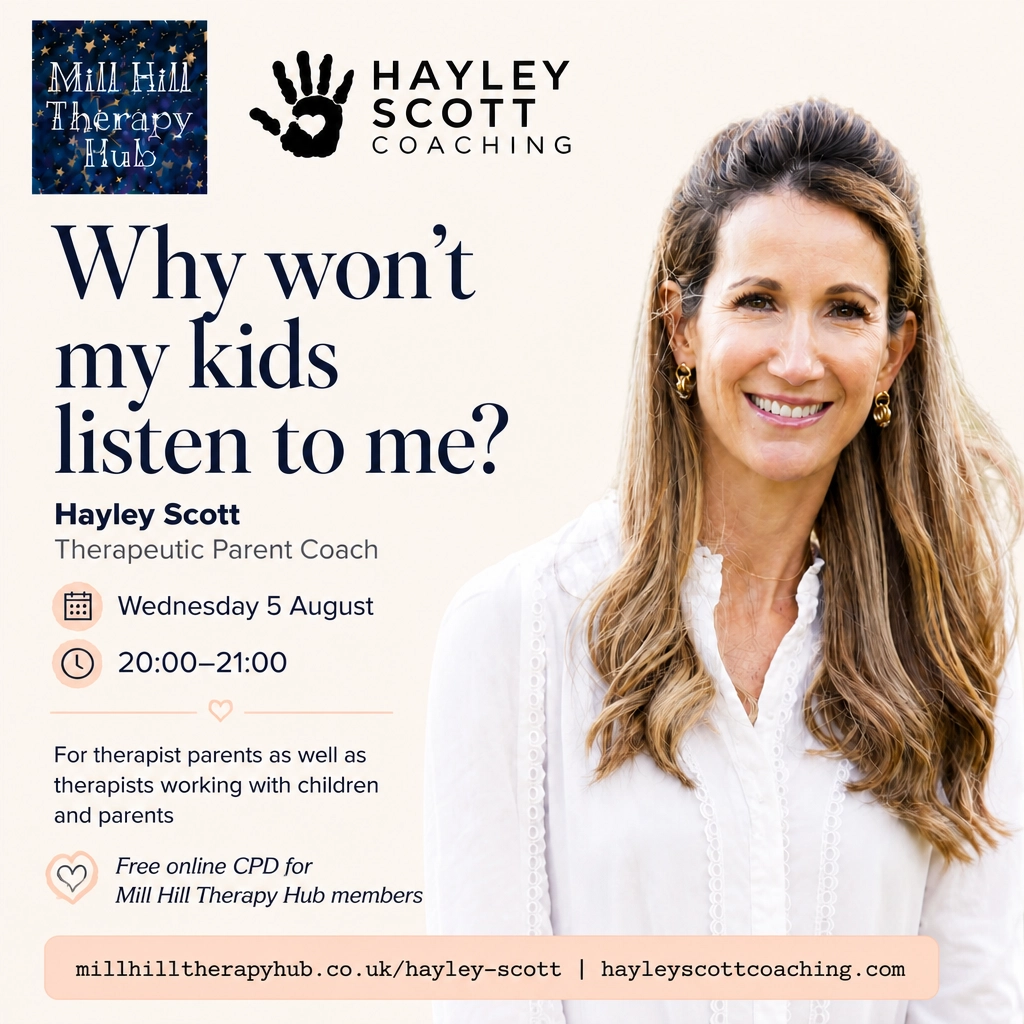
Recently, we had the absolute joy of hosting an incredible in-person session with our wonderful member and Therapeutic Parent Coach, Hayley Scott. If you haven’t yet explored her work, we warmly invite you to take a look at Hayley’s Hub profile over at Mill Hill Therapy Hub as well as her main website at Hayley Scott Coaching.
We had 12 of our brilliant members log on for this online session! 🛋️✨ Let us dive into some of the wonderful insights, heartwarming takeaways, and practical tools Hayley shared with us about one of the most common parenting struggles in existence.
Are you a practitioner? Why behaviour is communication 🧠💬
For those of us working with families, children, and adults, understanding the root of everyday friction is essential. Hayley kicked off our session with a powerful reframing: when kids do not listen, it is almost never about outright defiance or stubbornness. Instead, it is a nervous system signal! 🚦
When a child freezes, argues, or completely tunes out, their emotional brain has taken the wheel. Hayley reminded us that behaviour is always communication. Children are rarely giving us a hard time; they are almost always having a hard time.
By shifting our lens away from “my child is misbehaving” toward “my child’s nervous system is overwhelmed,” we instantly step out of the trap of frustration and into a place of deep empathy and curiosity. This mindset shift is a game-changer for both practitioners in their clinical work and parents at home. 🌿
Connection before direction 🤝✨
One of the standout golden rules of the workshop was a phrase we have been repeating to ourselves ever since: connection before direction.
How often do we find ourselves shouting instructions from across the house while unloading the dishwasher or replying to an email? We have all been guilty of it! 🙈 But Hayley explained that a child’s brain simply cannot process a command when they feel emotionally disconnected from us.
Before we ask a child to put their shoes on, turn off the screen, or sit at the dinner table, we need to bridge the gap. That means stepping into their world, getting down to eye level, offering a gentle physical touch on the shoulder, and acknowledging what they are currently absorbed in. When a child feels truly seen and heard by us, their nervous system settles down, and their cooperation naturally follows. It is such a simple yet profound reminder of how relationship always precedes compliance. ❤️

The 4-step framework for peaceful parenting 🧭
Hayley walked our group through a beautifully structured 4-step framework that provides a clear roadmap when navigating tricky moments with children:
- Understand behaviour: Look beneath the surface to see what unmet need or nervous system state is driving the reaction.
- Find the nervous system route: Notice whether your child is in fight, flight, or freeze mode, and respond with co-regulation rather than escalation.
- Set values-based boundaries: Hold firm, kind limits rooted in safety and family values rather than arbitrary rules or reactive punishments.
- Change the parent’s internal narrative: Notice your own triggers, stories, and stress responses so you can remain the calm, steady anchor your child needs. ⚓
Working through these four steps gives us as adults a wonderful sense of clarity. We do not need to have all the answers right away; we just need to stay grounded and present.
Effective phrasing tips: speaking a different language 🗣️✨
Changing how we speak to children can completely transform the dynamic in a room. Hayley shared some fantastic, practical phrasing tips that help bypass power struggles entirely:
- Avoid the word “you” in requests: Starting a sentence with “You need to…” or “You always…” instantly puts a child on the defensive. Shifting to neutral information works wonders.
- Use sports-casting: Describe what you see happening without judgment, just like a sports commentator: “I see shoes lying right by the front door.”
- State problems simply: “We have got two minutes before we need to walk out, and coats are still on the rack.” Let the reality of the situation do the teaching.
- Share feelings: “I feel a bit stressed when we are running late because I want us to arrive calmly.”
- Inject fun: Turn mundane transitions into a game, a race, or a silly challenge! 🎉
These gentle adjustments take away the confrontational edge and invite children to participate willingly rather than digging their heels in.
A thriving community of learning and growth 🌱☕
As part of our ongoing monthly CPD workshop series for members at the Mill Hill Therapy Hub, sessions like this remind us why community matters so much. Private practice can sometimes feel a little isolating, which is why we love bringing passionate practitioners together to share ideas, learn new modalities, and enjoy a cup of tea and a biscuit together.
Even better, because these monthly sessions are BACP-accredited for CPD hours, our members can easily log their attendance toward their professional development requirements while connecting with wonderful colleagues.
If you are a qualified therapist looking to grow your private practice in a supportive, warm environment across our four London locations, we would love for you to explore our membership and room rental options. You can take a peek at our contact page via Mill Hill Therapy Hub Contact or schedule a friendly, no-pressure 20-minute chat directly with Marc on his Calendly Link. We are always here for a chat! 🗓️☕
Looking ahead: What is next month? 📅👀
We are still buzzing from Hayley’s wonderful session, but we are already looking forward to next month’s gathering! For our next CPD workshop, Caron Barruw, the co-founder of therapeutic community Your Anchor, will be presenting on couples therapy, exploring relationships and therapeutic approaches. We cannot wait!
Thank you once again to Hayley Scott for sharing her incredible wisdom with us, and thank you to every single member who joined the Zoom or caught up on the recording later on. Here is to more learning, more connection, and supporting each other every step of the way. 🌟
0 Comments