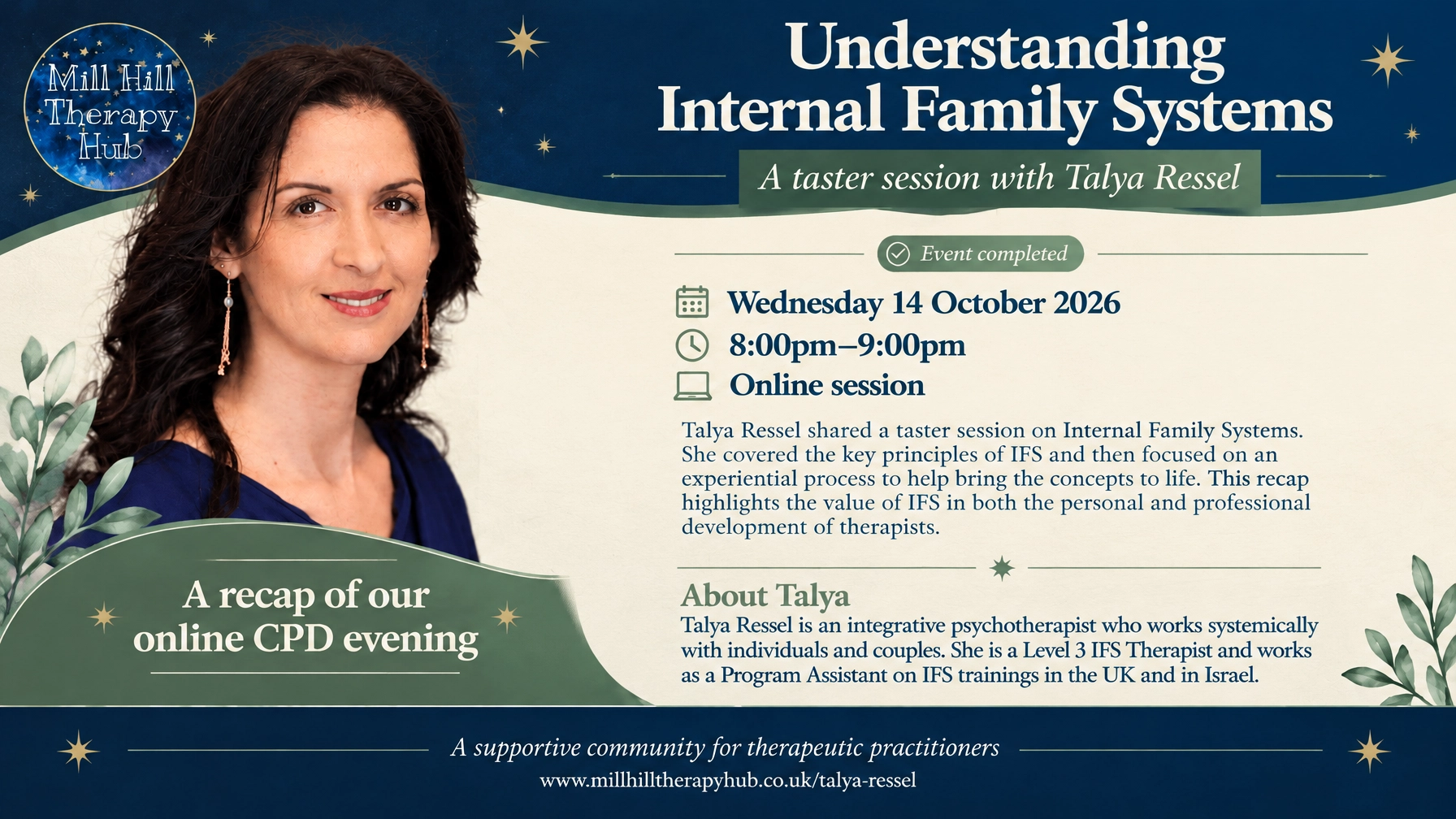
We were delighted to bring therapists together online for an evening of learning with Talya Ressel. Around 25 people joined us on Zoom on Wednesday 14 October, including eight non-members. The session offered a clear introduction to Internal Family Systems (IFS) and its compassionate way of understanding our inner experiences.
Who is Talya Ressel?
Talya is a London-based psychotherapist who has worked in South Africa and England for the past 18 years. She works with individuals, couples and families, with a focus on anxiety and high sensitivity. Talya is Level 3 trained in IFS and a Program Assistant on Level 1 trainings. Alongside her therapy work, she runs therapeutic groups and training workshops, consults with schools and organisations, and regularly contributes to radio and television in both the UK and South Africa.
You can read more on Talya’s profile, visit www.talyaressel.com or explore her about page.
What did Talya explain about IFS?
Talya introduced IFS as a non-pathological approach. It understands the mind as naturally made up of different “parts”, and holds that there are no bad parts. Each part has a positive intention, even when the way it tries to help can have a damaging impact.
She outlined three broad types of parts:
🔸 Exiles are young, vulnerable parts that carry pain or trauma.
🔸 Managers are proactive parts that try to keep life under control and protect us from difficult feelings.
🔸 Firefighters are reactive parts that jump in to stop pain as quickly as possible.
These roles help make sense of why some patterns can feel so persistent. IFS invites curiosity about what a part is trying to do, rather than treating it as a problem to get rid of.
What is the Self in IFS?
Beneath the parts, IFS describes the Self as an inner resource for leadership and change. Talya introduced the 8 Cs associated with Self-energy: curiosity, calm, clarity, compassion, confidence, courage, creativity and connectedness.
The Self cannot be broken. When people can access this grounded energy, they may be better able to understand protective parts without being completely taken over by them.
How can therapists apply the model?
A central point from the session was that therapists are not there to fix clients. Instead, they act as guides, supporting clients to reconnect with their own self-energy.
Talya described using “U-turns” and internal witnessing to help clients notice and unblend from protective parts. This creates room to approach inner experiences with greater curiosity and compassion, while keeping the client’s own capacity for change at the centre.
Where can members find the recording?
We shared the workshop flyer with non-members, and the recording is now available through the Mill Hill Therapy Hub workshops page, which full members can access.
What’s next, and would you like to speak at a future event?
We have more CPD next month. Join us online on Monday 23 November 2026, from 8:00pm to 9:00pm, for a session with Elizabeth Bergman on eating disorders.
If you would like to give a talk at a future event, we’d love to hear from you. Speakers are paid when non-members attend, while workshops remain free for full members. You can register your interest in giving a talk or book a chat with Marc to explore the idea.
0 Comments