
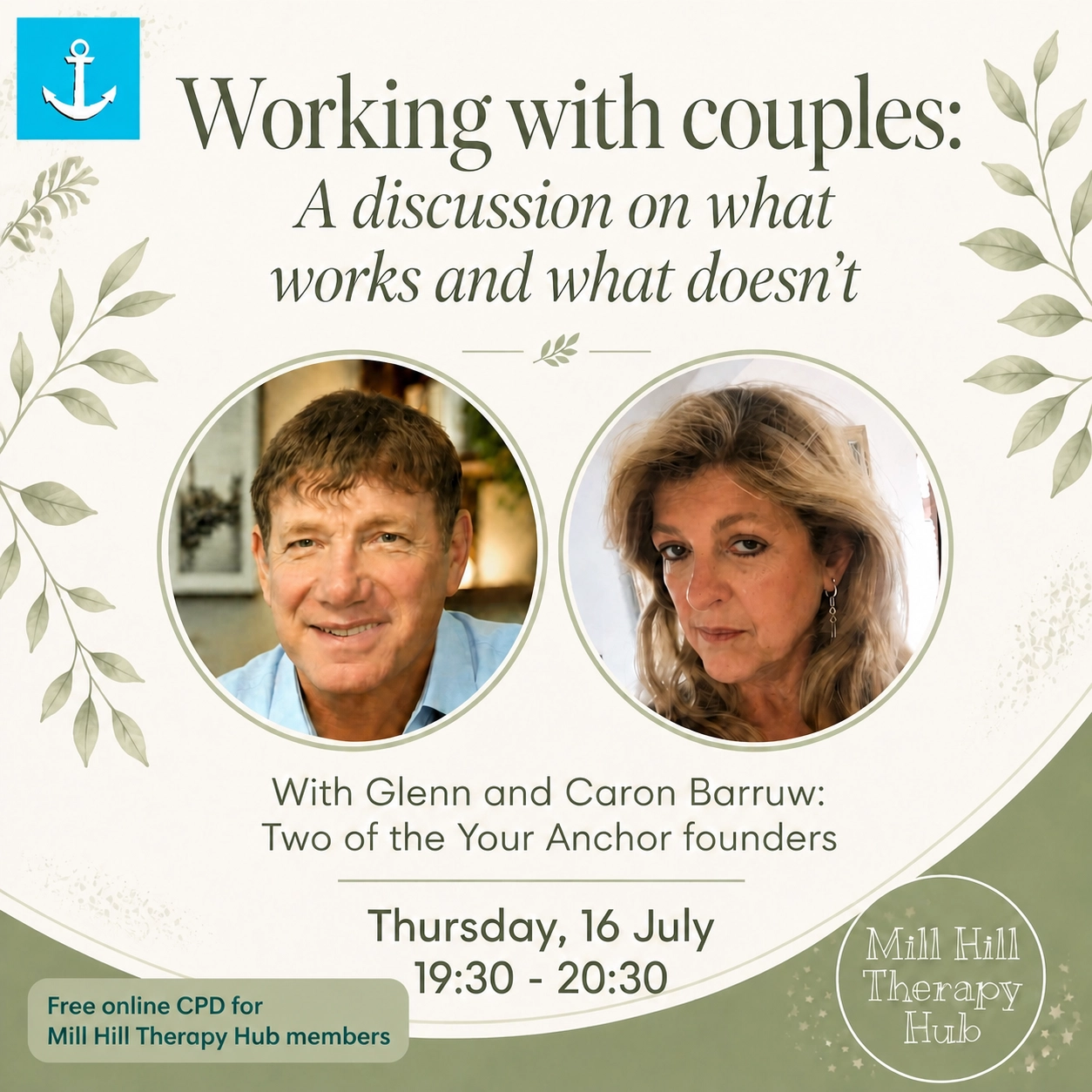
At the Mill Hill Therapy Hub, we’ve always believed that being a therapist shouldn’t feel like a solitary journey. Whether you’re working with individuals or couples, the work can be as challenging as it is rewarding, and having a supportive community behind you makes all the difference. That is why we were so thrilled to host our recent CPD workshop on 16 July 2026, focused on the intricate world of couples therapy. 🌿
We were also so pleased that 16 members joined us on Zoom as well, which made the session feel even more connected and inclusive. It was genuinely lovely to have a mix of in-person and online attendees, with people learning together from different spaces while still feeling part of the same conversation. 💻✨
We were incredibly lucky to be joined by the wonderful Caron and Glenn Barruw. They are a powerhouse husband-and-wife team with over 25 years of experience in the field. Watching them work together is a masterclass in itself; they bring a unique blend of professional expertise and the lived wisdom of a long-term marriage. Their workshop was packed with "aha!" moments, and we wanted to share some of those gems with our wider community of practitioners.
Whether you’re a seasoned couples counsellor or a therapist looking to expand your private practice into this area, these insights are designed to help you navigate the complexities of two people in one room (or three, if you count the relationship itself!). 🛋️
Are you treating the couple or the individuals?
One of the first things Caron and Glenn emphasised is the importance of a systemic approach. It is so easy to fall into the trap of "taking sides" or becoming an arbitrator between two competing narratives. However, in their view, the client isn't Partner A or Partner B: the client is the relationship itself. 🤝
By shifting the focus to the "third entity": the bond between the pair: the therapist can stay neutral and objective. This systemic lens allows us to look at the patterns, the circularity of their arguments, and the shared history that creates the current friction. When we treat the relationship as the client, we stop looking for who is "right" and start looking for what the relationship needs to thrive.
Moving beyond the surface-level arguments
A couple might spend forty minutes debating whose turn it was to empty the dishwasher or why someone was five minutes late for dinner. Caron and Glenn reminded us that these surface-level conflicts are almost never about the dishwasher. 🍽️
Their workshop dived deep into conflict resolution, teaching us how to peel back the layers of these everyday skirmishes to find the underlying emotional wounds. Usually, underneath the anger or the nagging is a plea for connection, a fear of abandonment, or a feeling of being undervalued. By helping couples identify these deeper needs, we can move them away from "tit-for-tat" arguing and towards genuine vulnerability.
Do you know the power of silence?

Caron spoke beautifully about something many therapists struggle with: silence. In a high-tension couples session, it can feel like we need to fill every gap with a clever intervention or a soothing word. But sometimes, the most profound work happens in the quiet moments. 🤫
Silence allows the couple to sit with what has just been said. It gives them space to feel the weight of an admission or the impact of a particular look. Caron encouraged us to be "relentlessly positive" about the potential of silence. Instead of rushing to fix the tension, we can hold the space and let the couple find their own way through the quiet. It’s often in these pauses that the most honest realisations bubble to the surface.
Setting firm boundaries against verbal abuse
Working with couples can sometimes get heated: really heated. One of the most practical takeaways from the workshop was the necessity of firm boundaries. Caron and Glenn were very clear: there is no room for verbal abuse in the therapy room. 🛑
As practitioners, we have a duty of care to ensure the space remains safe for everyone. This means being comfortable with interrupting, naming the behaviour, and even ending a session if a client becomes abusive. By instilling these boundaries early on, we model what a healthy relationship looks like: one where respect is a non-negotiable requirement. It isn't about being a "police officer"; it’s about creating a container where real, safe work can actually happen.
Is it time to talk about the "other" room?
It’s a topic that can make even the most experienced therapists feel a little twitchy: sex and intimacy. Yet, as Glenn pointed out during his sessions, a holistic assessment of a relationship is incomplete without it. 🛏️
Often, physical intimacy is the first thing to go when a relationship is in trouble, or conversely, it’s used as a temporary "plaster" for deeper emotional issues. Glenn shared how to ask those "brave questions" about a couple’s private life without making it feel clinical or intrusive. By bringing the conversation around sex into the room, we acknowledge that it’s a fundamental part of the human experience and a key indicator of the relationship's health.
Giving them the tools to work at home

While the work done in our lovely therapy rooms is vital, the real test happens in the 167 hours between sessions. Glenn is a big advocate for practical homework. 📝
This isn't about giving them "schoolwork," but rather about creating small, manageable "connection points." It could be a five-minute daily check-in, a "no-phone" hour, or a specific communication exercise. The goal is to help the couple build new habits and neural pathways that support their growth. When couples leave a session with a clear, actionable task, they feel empowered to take ownership of their own healing.
Connecting with the wider community: Your Anchor
One of the highlights of the day was discussing how we can stay connected as professionals outside of these workshops. This is where Your Anchor comes in! ⚓
Your Anchor (youranchor.com) is a private online community designed specifically for mental health professionals. It’s a space to chat, share resources, and find support from peers who truly "get" the ups and downs of the job. Since we’re all about community at the Mill Hill Therapy Hub, we’ve partnered with them to offer something special.
If you’re a Hub member or just a reader of our blog, you can get a free 90-day trial of Your Anchor using the code MHTH. It’s a wonderful way to see if the platform is right for you. After the trial, it’s just £12 a month for standard members or £8 a month for students. It’s a small investment for a whole lot of peer support!
Why we love what we do at the Hub
Hosting workshops like this reminds us why we started the Mill Hill Therapy Hub in the first place. We aren't just a business that rents out therapy rooms by the hour; we are a family-run hub that cares deeply about the practitioners who walk through our doors. 🏠
Whether you are using our Sunbury Avenue adult room for a quiet session or joining us for one of our Thursday evening social events, we want you to feel at home. Our annual membership is designed to help you grow: not just by giving you a place to work, but by listing you on our website, promoting you on our socials, and feeding you referrals to help your practice bloom.
We know that being a therapist can sometimes feel like you're on an island. Our mission is to build the bridge that connects you to other like-minded professionals. From our little libraries in the waiting areas to our unwavering commitment to making your room bookings seamless, we have an eye on every detail so you can focus on what you do best: helping your clients. ✨
Are you ready to join us?
If you’re looking for a warm, inclusive space to host your sessions in London, or if you’re a therapist who wants to be part of a vibrant, supportive network, we would love to hear from you.
We have six beautiful rooms across four sites, all designed with a penchant for comfort and professionalism. Whether you need a room for a one-off session or a regular block booking, our system is streamlined and easy to use.
If you have questions about our rooms, our membership, or how we can support your journey as a therapist, there are a few ways to get in touch. You can visit our contact page to send us a message, or if you’d prefer a quick chat, you can book a 20-minute call with Marc on his Calendly. We are always open to a conversation! 💬
We can't wait to see you at our next event or in one of our rooms soon. Until then, keep doing the amazing work you do!
0 Comments