
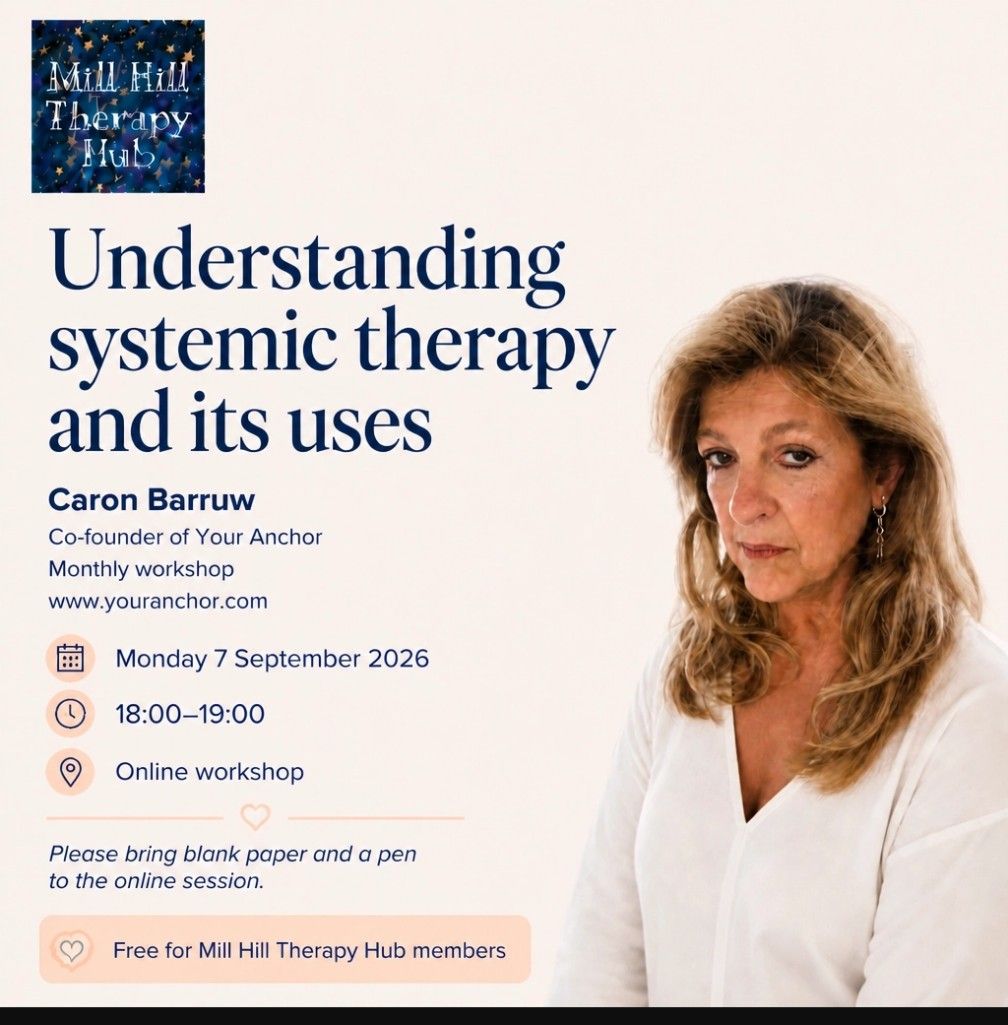
At the Mill Hill Therapy Hub, we believe that shared learning is one of the most valuable parts of being part of a therapy community. Our workshops give practitioners the chance to pause, listen, reflect and learn from one another in a warm and supportive setting 😊
On Monday 7 September 2026, we came together online for a one-hour workshop on Systemic Therapy, led by Caron Barruw. The session took place on Zoom, with Caron as the main speaker.
The focus was genograms, family tree diagrams that can help bring family relationships, patterns and wider context into view. Here are some of the key points we took from the session.
What is systemic therapy?
Caron began by introducing her background in systemic therapy before exploring how she uses family history and family relationships in her sessions.
Systemic therapy considers a person within the context of their relationships and wider background. This means that therapy can include thoughtful exploration of family dynamics, connections and the experiences that have helped shape someone’s history.
It is not simply about drawing a family tree. The process can open up conversations about how people relate to one another and how family relationships may be understood within therapy.
As Caron explained, this work starts with curiosity. The therapist and client can look together at the family context and consider what may be important to explore.
What is a genogram?
A genogram is a family tree diagram used in therapy to understand a client’s history and background.
Unlike a basic family tree, which usually focuses on who is related to whom, a genogram can help bring relationships and family dynamics into the conversation. It creates a visual starting point for exploring the family story.
During the workshop, Caron explained how she begins drawing a genogram by looking at parents, siblings and grandparents. From there, the diagram can help organise information about the family and support further discussion.
The diagram is not the therapy itself. Rather, it is a tool that can help make parts of a family history easier to see and talk about. Sometimes a visual representation can help a client and therapist hold different pieces of information in view at the same time 🌿
How are genograms drawn?
Caron walked us through the process of drawing a genogram in a clear and practical way.
The starting point is often the client’s immediate family. This includes parents and siblings, followed by grandparents. The therapist can then build up the diagram as the conversation develops.
The process may include exploring:
- Who is included in the family
- How family members are connected
- The relationships between different people
- Family dynamics that may be important to the client
- The wider context surrounding the client’s history
The diagram develops through conversation. It is not about rushing to complete a fixed template. Instead, it provides a way of gathering and organising information while staying attentive to the client’s experiences.
This collaborative approach matters. A genogram represents a family as it is understood within the therapeutic conversation, rather than offering a detached or definitive account of every family relationship.
How can genograms support therapeutic conversations?
One of the main ideas from the workshop was that genograms can help bring family relationships and patterns into view.
Family histories can be complex. They may include many people, different relationships and experiences that are not always easy to hold in mind all at once. A genogram can offer a simple visual structure for looking at that complexity.
It may help the therapist and client explore questions such as:
- Who has been important in the client’s family story?
- How do family members relate to one another?
- Are there particular dynamics that the client wants to understand?
- What wider family context may be relevant to the client’s experiences?
These questions are not about making assumptions. They are invitations to explore. The meaning of a relationship or pattern belongs to the client and needs to be understood carefully within the therapy.
This is where systemic thinking can be especially valuable. Rather than considering a person’s experiences in isolation, the conversation can include the relationships and background around them.
What did we take from Caron’s workshop?
We appreciated the way the session connected a practical tool with the wider principles of systemic therapy.
A genogram can look straightforward on paper, but the conversations around it are important. Drawing parents, siblings and grandparents is only the beginning. The value comes from taking time to understand the relationships, dynamics and context that sit behind the diagram.
We were also reminded that therapeutic tools need to be used thoughtfully. A genogram is not a checklist and it is not a way to make quick judgements about a family. It is a way of supporting curiosity and creating space for a client’s history to be explored.
For practitioners, this kind of workshop offers an opportunity to refresh existing knowledge and hear how another member works. For the wider community, it helps us keep learning from the different perspectives and approaches within the Hub ✨
Who took part?
We would like to recognise the members who attended or were involved in the workshop.
- Caron Barruw, who led the session and was the main speaker
- Yasmin Ghanim
- Simon Glazer
- Sarah Cheyette-Cohen
- Saskia Joss
- Rochelle Gould
- Esther Ebbing
- Jo Bradburn
- Rommy Simon
- Simon Lister
Thank you to everyone who made time to join us and contribute to the shared learning environment. We know that working in mental health can be demanding, so creating opportunities to connect and learn together is something we value greatly.
What is Your Anchor?
Your Anchor is a community platform and co-founder of the Mill Hill Therapy Hub monthly workshop series.
Members can join Your Anchor using code MHTH for a 90-day free trial.
What’s coming up?
The September workshop is part of an ongoing programme of talks and workshops for members of the Mill Hill Therapy Hub.
In October, Rotem Metuki will run an in-person workshop on RAWR.
Dates are also being finalised for an Internal Family Systems talk with Talya Ressel. We are also finalising dates for an eating disorders workshop with Elizabeth Bergman.
These workshops and talks are part of being a member of the Mill Hill Therapy Hub. They are available at no additional cost beyond membership, giving practitioners regular opportunities to learn from one another and stay connected to our community 📚
We will share further details as the dates are confirmed.

Would you like to be part of the community?
Membership at the Mill Hill Therapy Hub is designed for qualified therapists and mental health practitioners who want more than access to a therapy room.
Our members can benefit from therapy room rental across our London locations, a practitioner profile, referrals, social media promotion and invitations to community events and learning opportunities. We aim to make the practical side of private practice feel more streamlined while creating a warm and inclusive professional network.
Members can also join our WhatsApp community and choose the areas or groups that feel most relevant to them, including peer supervision or practitioner communities that match their interests and way of working.
You can explore our Services and Membership to find out more about how it works.
If you would like to ask a question or talk through your options, you can contact the Hub or book a friendly 20-minute call with Marc via Marc’s Calendly. We are always happy to talk things through and help you decide whether the Mill Hill Therapy Hub feels like the right fit for you 😊
0 Comments